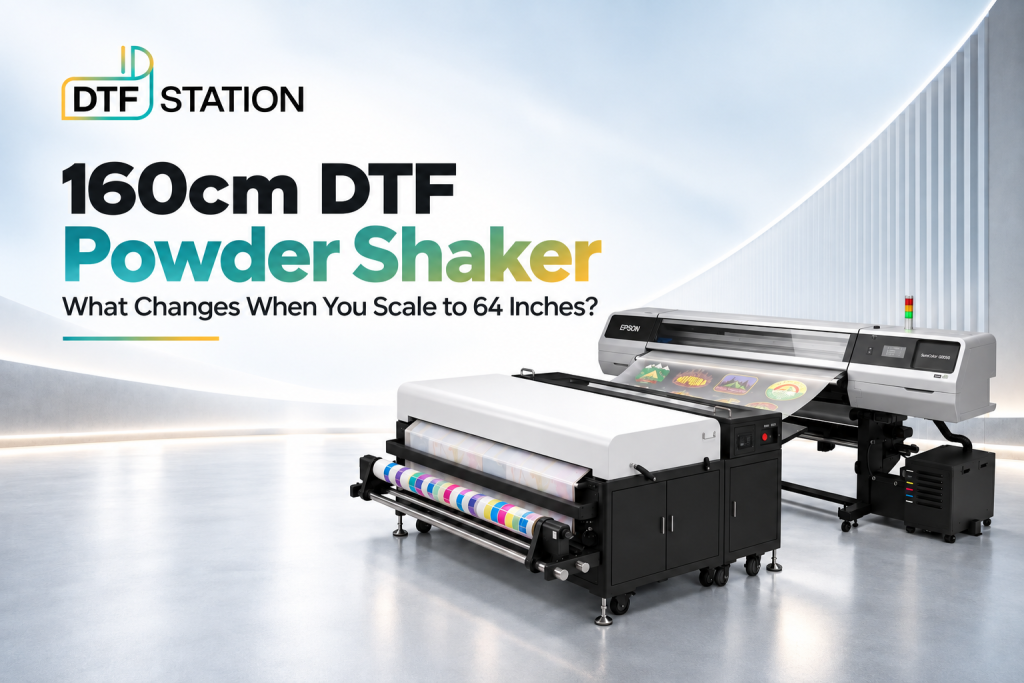
Moving from 60 or 90 cm DTF production to 160 cm / 64-inch production is not simply a matter of buying a wider printer and a wider shaker.
At this scale, small problems become wide problems.
Uneven heat across the film can become inconsistent curing across 1.6 meters. Poor media control can become film waves or tracking problems. A shaker that cannot maintain the required production speed can turn a fast printer into an expensive waiting machine.
The short answer: a good 160cm DTF powder shaker must do five things well at the same time—cure consistently, keep up with the printer, control wide film, handle powder and fumes properly, and fit the real production facility.
That is what industrial DTF users should evaluate.
1. Start With Throughput—Not Width
A 160cm dtf powder shaker that accepts 160cm film is not automatically a good match for a 160cm printer.
The more important question is:
Can it cure the film correctly at the speed your printer actually produces it?
Consider the Epson SureColor G9070. Epson publishes production speeds up to 350 ft²/h, or approximately 32.5 m²/h. It also supports simultaneous twin-roll printing.
That gives the finishing system a demanding job.
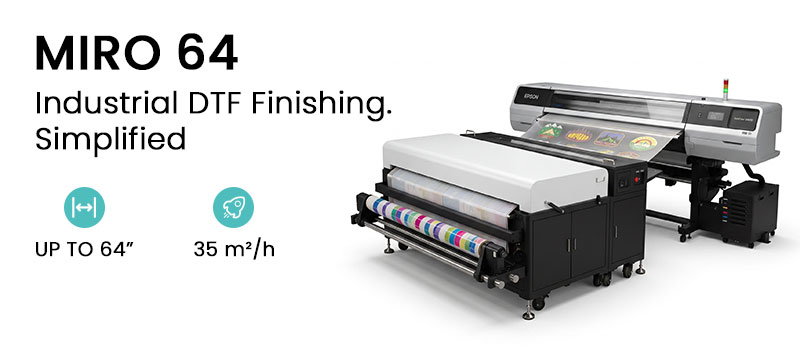
For comparison, Miro 64 is designed for finishing speeds up to 35 m²/h. On published maximum figures, that puts its nominal finishing capacity slightly above the G9070’s published maximum print throughput.
But that does not mean you should simply compare 35 versus 32.5 and consider the system matched.
Real curing speed depends on:
- ink coverage;
- powder chemistry;
- film;
- heating temperature;
- dwell time;
- airflow;
- ambient conditions.
A manufacturer should therefore be able to demonstrate sustained curing at the speed you plan to run, not simply quote the maximum conveyor speed.
Manufacturer’s rule of thumb
Printer speed tells you how quickly film arrives. Curing performance tells you how quickly properly finished film can leave.
Your usable production speed is controlled by the slower of the two.
2. At 160cm, Heat Uniformity Matters More Than the Temperature Number
A common specification is something like:
“Heating temperature: 120–160°C.”
That number tells you very little about how evenly a 160cm roll actually cures.
The temperature shown on the control panel is a setpoint. What matters to the transfer is what happens to the film across its entire width while it is moving through the curing system.
With 160cm media, evaluate at least:
Left edge → center → right edge
Then evaluate those points at your normal production speed.
Why?
Because an industrial operator does not need the middle 60cm of a 160cm roll to cure correctly. The entire printable width has to behave consistently.
Operators in DTF communities regularly troubleshoot problems where film waves or edge areas cure differently from the center. Tension, vacuum, alignment and heating can all contribute, which is exactly why a wide-format curing problem should not automatically be treated as a simple “increase the temperature” issue.
What to ask the supplier
Instead of:
“How many heating zones does it have?”
Ask:
“Can you show curing or temperature consistency across the full 160cm width while running at production speed?”
That is a much harder—and much more useful—question.
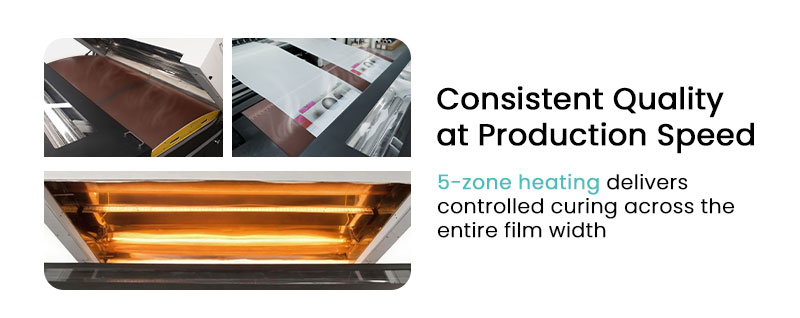
Miro 64 uses five independently controlled heating zones together with bottom heating, specifically to provide more control across wide-format continuous production.
3. Watch the Film, Not Just the Heater
At 24 inches, slight film movement may be manageable.
Across 64 inches, the same instability can become:
- wrinkles;
- edge lift;
- uneven oven exposure;
- wandering film;
- take-up problems;
- inconsistent powder removal.
This is why film tension, sensing, alignment and take-up behavior deserve almost as much attention as the heating system.
One recent operator troubleshooting a shaker described film developing visible waves even when running blank PET film through the machine. Adjusting temperature, belt speed, take-up and alignment all became part of the diagnosis.
That example matters because it shows why wide-format DTF cannot be diagnosed from temperature alone.
When evaluating a 160cm DTF powder shaker, ask to see:
a full-width roll running continuously—not a 30-second demo using a narrow graphic in the center.
Look at the edges. Watch the film entering the powder section, entering the heating area and reaching the take-up.
That often tells you more than the specification sheet.
4. “Automatic Powder Recycling” Is Not the Same as Better Powder Control
Automatic recycling sounds like an obvious advantage.
Sometimes it is.
But powder handling is more complicated than simply returning every collected particle to the hopper.
A closed-loop system can reduce manual handling and powder waste. It can also introduce another mechanical path where powder must remain dry, clean and free-flowing.
One commercial DTF operator described a spiral powder recirculation system crushing or heating some powder, creating material that eventually had to be cleaned from the powder basket to maintain coverage. That is one user’s experience rather than a universal outcome, but it illustrates an important engineering trade-off.
Moisture is another factor. Operators frequently troubleshoot powder clumping and unwanted adhesion alongside humidity, film condition, static and white-ink overspray.
So ask more specific questions:
How is excess powder removed?
Where does collected powder go?
How easy is the powder path to inspect and clean?
Does recycled powder mix immediately with fresh powder?
How much operator cleaning is required?
Miro 64 uses automatic powder feeding and collection, but collected powder is not automatically recirculated into the feed system. That is worth stating clearly rather than presenting every form of automation as automatically superior.
5. Fume Management Is a Production Requirement, Not a Marketing Checkbox
Industrial DTF means more film, more powder and more material passing through a heated process.
That makes air management increasingly important.
Community discussions from commercial print shops repeatedly raise powder exposure, fumes and ventilation as concerns.
DTF Station’s own DTF powder handling guidance also instructs operators not to inhale powder or fumes and to use appropriate protective equipment.
So “built-in purifier” should not be the end of the conversation.
Ask:
What is being filtered?
What filter stages are used?
How often are filters replaced?
Where is oil or condensate collected?
Can the shaker connect to an existing facility extraction system?
What ventilation does the manufacturer recommend?
Miro 64 includes a built-in purifier with replaceable filters and an oil collection box, while allowing facilities with existing extraction infrastructure to use an external system instead.
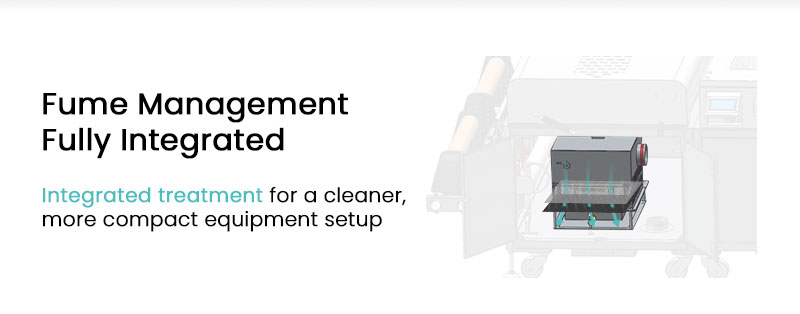
During product-team validation, the system reportedly operated for 10 continuous hours at up to 35 m²/h without visible smoke. That should be understood exactly as stated: an observed result under that test condition—not a claim of zero emissions or zero ventilation requirements.
That distinction matters.
6. Check the Electrical Panel and the Door Before You Buy
One of the least interesting specifications on a product page can become one of the most expensive details after delivery:
power requirement.
Current 1600mm machines already illustrate how different two similarly sized systems can be.
One current 1.6m system advertises maximum power around 4.2 kW, while another 1600mm industrial powder shaker publishes a 10 kW rating.
Same general width. Very different site implications.
Do not request only “voltage.”
Before purchasing, confirm:
Voltage · Phase · Amperage · Breaker · Outlet/connector · Rated power · Expected operating consumption
Then check the physical route into the production area.
A wide-format shaker can weigh hundreds of kilograms. Loading dock access, crate size, corridors, elevators, doorways and final service clearance all matter.
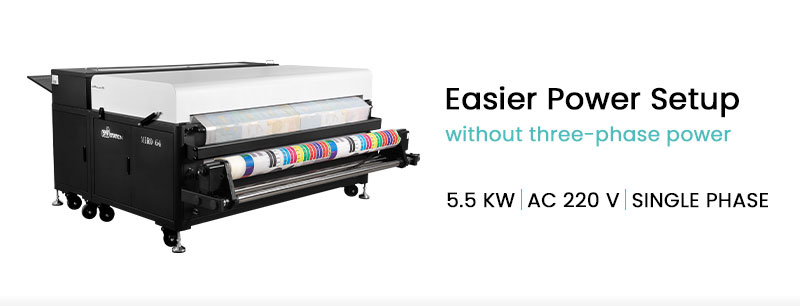
Miro 64 has a published machine weight of approximately 480 kg / 1,058 lb, operates at 5.5 kW, AC 220V single phase, and is designed for installation through a standard 36-inch doorway.
A site survey should still be part of an industrial installation.
Do not discover the delivery-route problem when the truck arrives.
7. Ask Whether You Really Need to Run 160cm All Day
A wide-format machine should not become inefficient every time a smaller job enters production.
This matters particularly now because some 64-inch printers are being designed around flexible media workflows.
The Epson G9070, for example, supports simultaneous twin-roll printing.
Miro 64 follows the same production logic on the finishing side:
1 × 64″ roll
or
2 × 24″ rolls
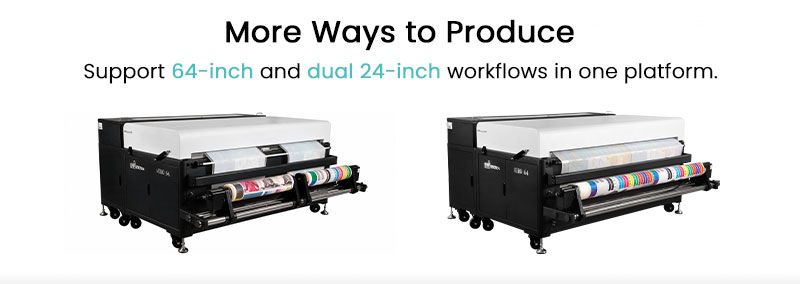
That means the system can be used for full-width production without restricting every shift to full-width jobs.
For a production manager, that flexibility can be more important than another headline feature.
The 60-Second 160cm DTF Powder Shaker Checklist
| Check | What You Should Ask |
|---|---|
| Throughput | What speed can it sustain while achieving the required cure—not just move film through the oven? |
| Heat | How consistent is curing across left, center and right at production speed? |
| Film control | Can I see a continuous full-width run and watch tracking from printer to take-up? |
| Powder | How is excess powder removed, collected and/or recycled? |
| Fumes | What filtration is included, what are replacement requirements, and can external extraction be connected? |
| Electrical | Voltage, phase, amps, breaker, connector and rated/actual operating power? |
| Installation | Machine and crate dimensions, weight, doorway requirement and unloading method? |
| Maintenance | What must an operator clean daily and weekly, and how long does it take? |
| Support | Who installs it, trains operators, stocks parts and handles a production-down service call? |
If the supplier cannot answer these questions clearly, the machine’s width should not be the deciding factor.
Where Miro 64 Fits
Miro 64 was developed for shops moving into the current 36–64-inch industrial DTF printer class, including workflows such as Epson’s G9070.
Its core specifications include:
- 64″ / 162.6 cm maximum film width
- Up to 35 m²/h finishing capacity
- 1 × 64″ or 2 × 24″ production
- Five independently controlled heat zones + bottom heating
- 5.5 kW · AC 220V · single phase
- Designed to fit standard 36″ doorways
- Automatic powder feeding and collection
- Film sensors and tension control
- Built-in purifier plus external extraction option
It is also important to understand what Miro 64 is not.
It does not automatically recirculate collected powder back into the feed system. And its published maximum finishing capacity is 35 m²/h.
If your printer routinely produces film substantially faster than 35 m²/h in the production mode you intend to use, Miro 64 should not be positioned as the matched finishing system without further workflow validation.
That is how industrial equipment should be specified: match the system to the real production requirement, not the widest number on the brochure.
Frequently Asked Questions
What is a 160cm DTF powder shaker?
A 160cm DTF powder shaker is an automated finishing system designed to apply hot-melt adhesive powder to printed DTF film, remove excess powder and cure the transfer across media up to approximately 1600mm or 64 inches wide.
It is typically used with industrial or wide-format DTF printers.
Is a 160cm powder shaker just a larger 60cm shaker?
No.
The basic DTF process is the same, but wider media makes heat uniformity, film tracking, tension, powder control, take-up, fume handling and installation requirements more critical.
Simply scaling the width does not guarantee industrial production performance.
How fast should a 160cm DTF powder shaker be?
Its validated curing throughput should meet or exceed the printer’s normal production throughput.
Do not compare maximum conveyor speed with maximum printer speed alone. Ask for sustained production tests using your film, powder, ink coverage and intended cure conditions.
Does a 160cm shaker need automatic powder recycling?
Not necessarily.
Automatic recycling can reduce manual powder handling, but system design, powder condition, contamination control and cleaning requirements also matter.
Evaluate the complete powder workflow rather than treating “auto recycle” as a standalone measure of machine quality.
What printers use a 160cm DTF powder shaker?
Typical applications include 1.6m-class DTF printers such as the Epson SureColor G9070/G9000 and Mimaki TxF300-1600, plus other wide-format DTF printers whose production speeds and media handling are compatible with the finishing system. Epson’s G9070 supports media up to 64 inches and Mimaki lists up to 1,610mm print width for the TxF300-1600.
What should I test before buying a 160cm DTF powder shaker?
Ask for a continuous, full-width production test.
Watch curing consistency across the entire roll, film tracking, powder removal, take-up stability and fume behavior. Then verify power, installation access, maintenance requirements and support before finalizing the purchase.
The Bottom Line
At industrial DTF scale, the shaker is part of the production line—not an accessory behind the printer.
The best 160cm DTF powder shaker is therefore not automatically the machine with the most heaters, the highest temperature, automatic recycling or the longest feature list.
It is the system that can:
keep up with your printer,
hold the cure stable across the full width,
move film consistently,
manage powder and fumes,
and fit the infrastructure of your shop.
If you are planning a move to 64-inch DTF production, evaluate those five things first.
Explore the Miro 64 DTF Powder Shaker & Curing System to see how DTF Station approaches wide-format finishing.