
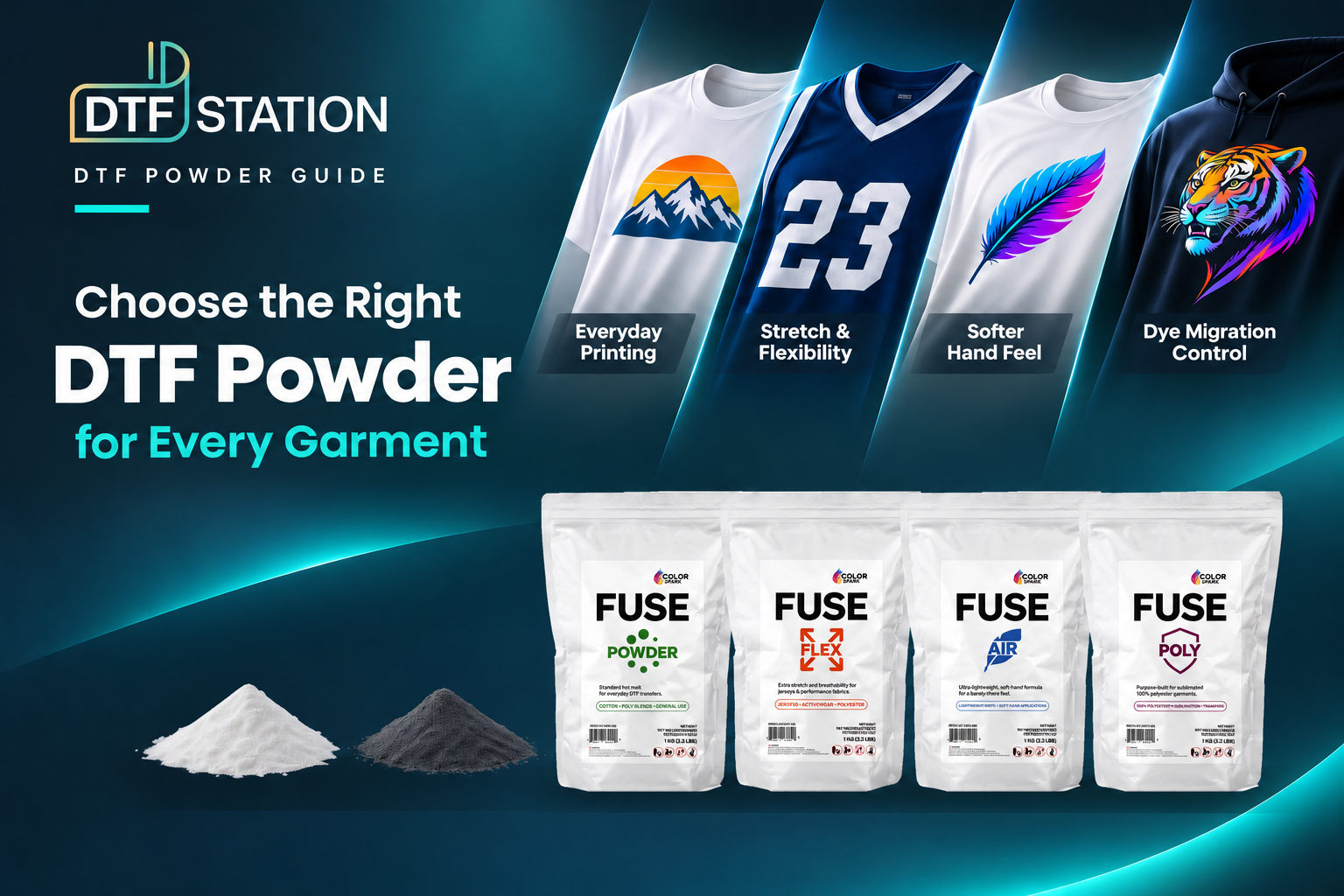
A soft fashion T-shirt, a stretch jersey, and a dark polyester uniform can all use DTF printing. But should they use the same adhesive powder?
Not necessarily.
For garment decorators, the right DTF powder does more than hold a transfer in place. It affects how the print feels, how it moves with the fabric, and how well it performs through wear and washing. Specialized powders can also help manage problems such as dye migration on polyester.
The best DTF powder depends on the garment, the intended application, and the performance your customer expects. Standard powder is a practical starting point for many everyday jobs. Other formulations are worth evaluating when softness, stretch, or dye resistance becomes a priority.
Here's how to make that choice.
What Does DTF Powder Actually Do?
DTF hot-melt powder is the heat-activated adhesive that bonds a printed transfer to fabric.
During production, powder is applied to the wet ink on DTF film. The excess is removed, and the coated design passes through a curing stage. Heat melts the powder into an adhesive layer, which bonds the print to the garment during heat pressing.
That adhesive layer plays a major role in the finished transfer's performance.
Wash durability, soft hand feel, and dye-migration resistance can require different adhesive properties.
This is why selecting powder solely by particle size or price doesn't tell the whole story.
For a print shop, the more useful question is: What does this garment need the transfer to withstand or deliver?
Which DTF Powder Should You Use?
Start with the intended result, not the powder specifications.
| Your printing requirement | Powder to evaluate | Typical applications |
|---|---|---|
| Reliable adhesion for everyday production | Flex Standard | Cotton T-shirts, hoodies, common blends |
| Greater flexibility for stretch garments | Fuse Flex | Sportswear, jerseys, stretch apparel |
| Softer feel for comfort-focused clothing | Fuse Air | Premium T-shirts, fashion apparel, branded merchandise |
| Reduced risk of dye migration | Fuse Poly | Dark polyester and dye-prone performance fabrics |
These recommendations provide a starting point. The final choice still depends on the garment, film, ink, curing conditions, and transfer testing.
Fuse™ Standard Hot Melt: Your Everyday Production Starting Point
Not every print job needs a specialty adhesive.
For shops producing everyday cotton T-shirts, hoodies, and common blended garments, general-purpose hot-melt powder offers a straightforward production option.
Color Prime's standard Hot Melt Powder is intended for these routine garment-decoration applications.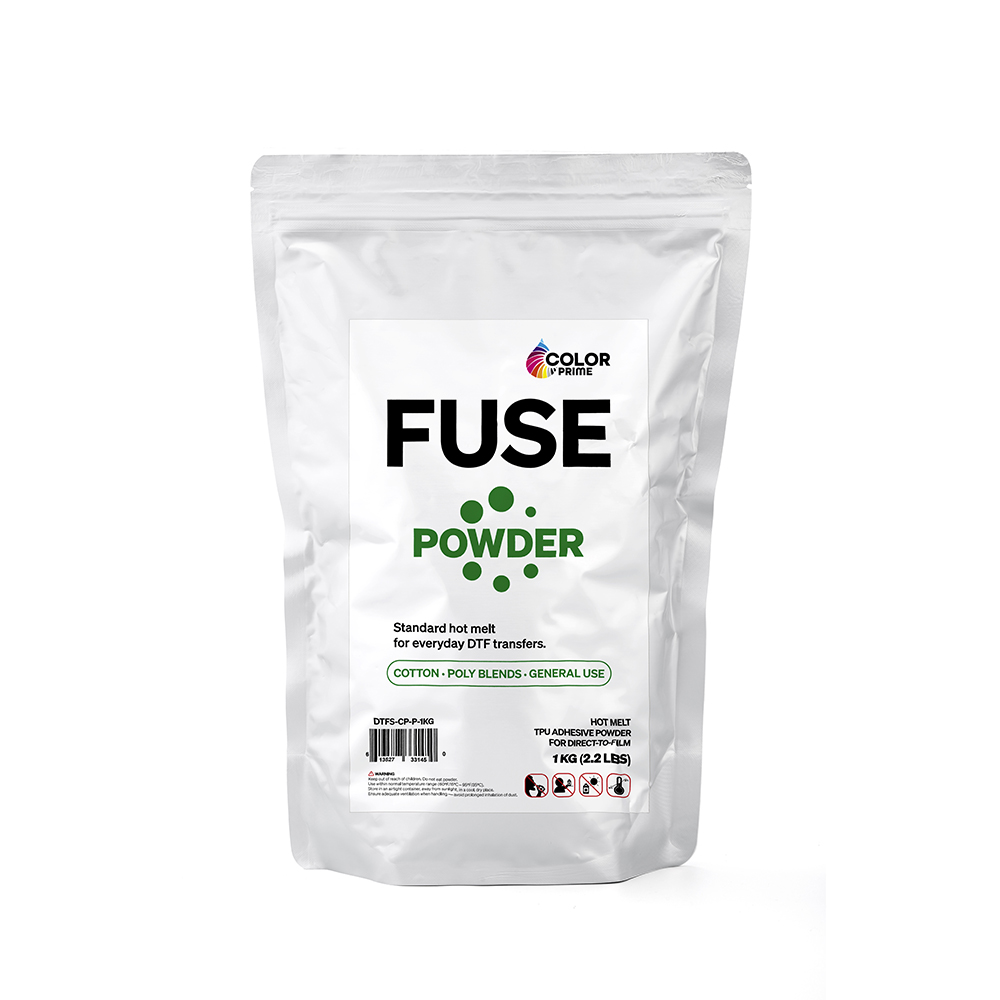 If your current powder already delivers acceptable adhesion, wash performance, and hand feel, there's no need to complicate production.
But when a customer requests a softer finish, the fabric stretches significantly, or polyester dye migration becomes a concern, it's worth evaluating a more application-specific powder.
Fuse Flex™: When the Print Needs to Move
Think about the difference between a casual T-shirt and a fitted athletic jersey.
A print on a stretch garment has to accommodate repeated movement. When the transfer layer cannot flex sufficiently, cracking, edge lifting, or reduced durability may become a problem.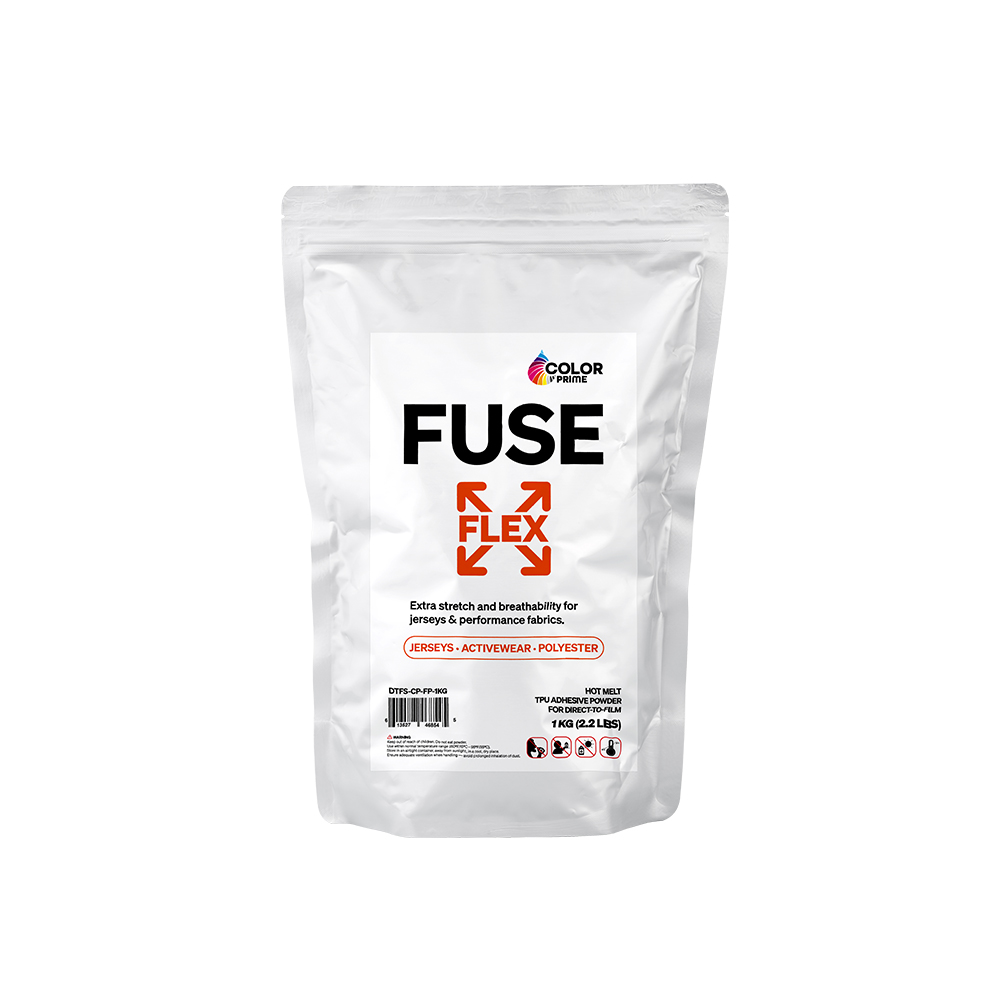 Color Prime Flex Powder is formulated for improved flexibility and soft hand feel, making it an option for sportswear and other garments that need to stretch.
This matters for garment decorators producing athletic uniforms, performance apparel, and fitted clothing.
However, flexibility doesn't depend on powder alone. Large solid designs, ink coverage, fabric stretch, and processing conditions all influence the final result.
What to test: Stretch the decorated garment in its normal direction of use, then check the design for cracking, distortion, and edge lifting. Repeat the assessment after washing.
Fuse Air™: When Comfort Is Part of the Product
A print can look excellent and still feel too heavy on the garment.
For premium T-shirts, fashion apparel, and branded merchandise, the tactile experience can be part of what customers are paying for.
A stiff print across the chest may be especially noticeable on lightweight or soft fabrics.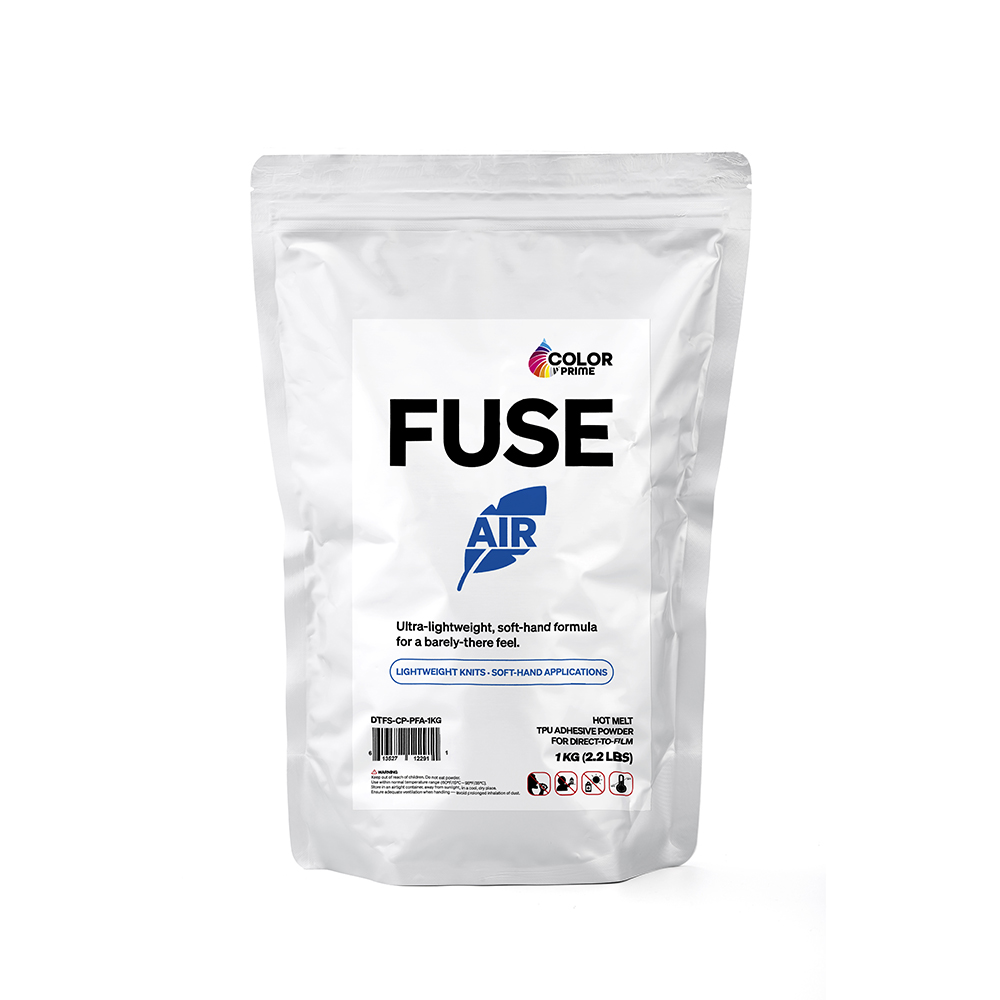 Color Prime Fuse Air is developed for these comfort-focused applications. It is positioned as the softest-feel powder tier in the range, with a specified particle size of 60–120 μm.
Its fine-particle formulation is intended to support even coverage and a softer finished feel.
For print shops supplying apparel brands or premium merchandise, Fuse Air provides another option to evaluate when hand feel is a key part of the customer's quality expectations.
What to test: Press identical artwork onto the same garment using your current powder and Fuse Air. Compare the finished feel, flexibility, appearance, and wash performance under consistent conditions.
Remember that finer powder alone does not guarantee a soft print. Artwork design, adhesive coverage, and processing also influence how a transfer feels.
Fuse Poly™: When Polyester Dye Migration Is the Problem
You press a white design onto a dark polyester jersey. The transfer looks clean at first, but later develops an unwanted pink or gray tint.
This is one example of dye migration.
Heat can cause certain dyes in polyester fabric to migrate into the printed transfer, changing its appearance. Some fabrics are more susceptible than others.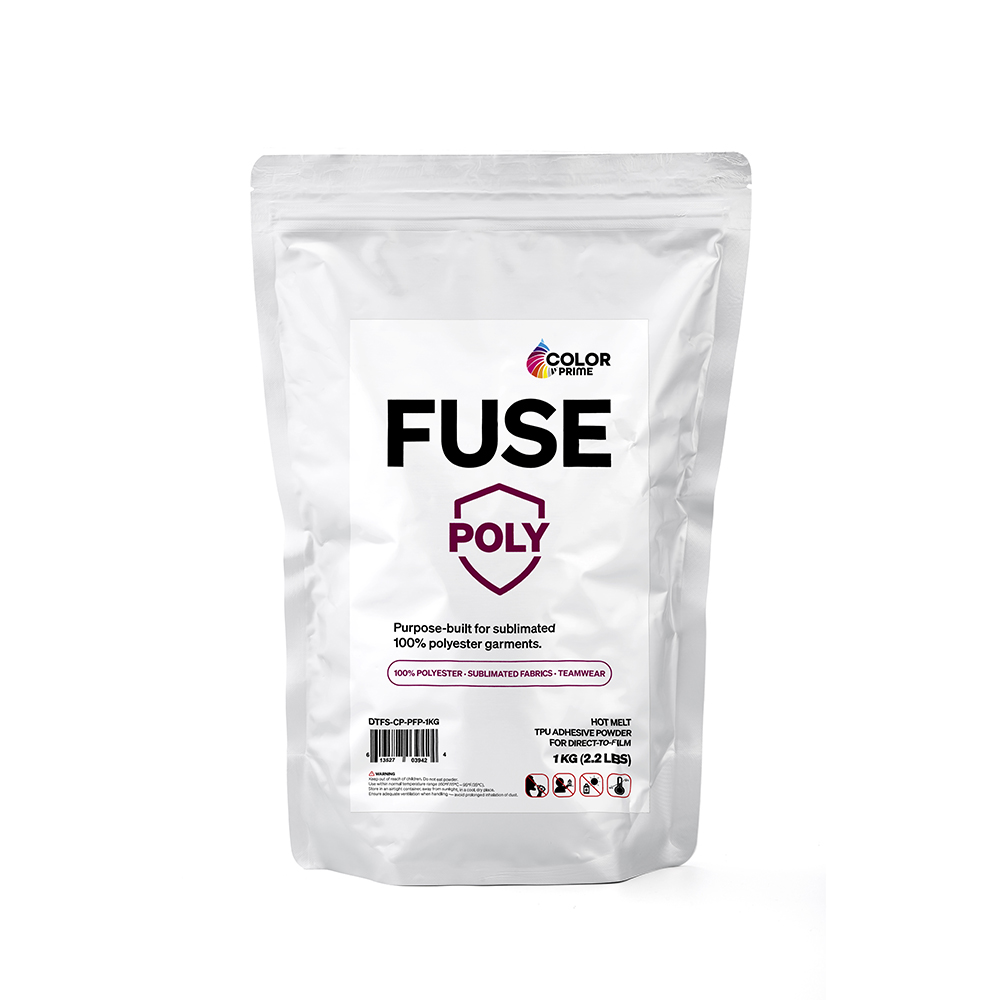 Color Prime Fuse Poly is designed to help reduce dye migration on dark, dye-prone fabrics while providing the adhesion needed for a usable transfer.
It is particularly relevant when decorating polyester garments with light-colored graphics.
But not every dark polyester garment behaves the same way. Dye formulation, fabric finishing, and heat exposure all influence the risk.
What to test: Apply a light-colored design to the actual garment. Inspect it immediately after pressing and again after a suitable observation period. Compare any color changes against an approved reference sample before starting the full order.
Anti-migration powder can help reduce dye bleed, but it should not be treated as a universal guarantee.
What if a Garment Needs More Than One Powder Benefit?
Real production jobs don't always fit neatly into one category.
Consider a dark polyester sports jersey. It may need enough flexibility for movement while also presenting a risk of dye migration.
Which requirement should take priority?
Start by identifying the problem most likely to cause the job to fail.
If your previous transfers have developed discoloration, dye migration needs to be addressed. If prints crack during normal wear, flexibility is a critical requirement.
For garments with both risks, compare suitable adhesive formulations on the actual fabric and evaluate both properties. Do not assume that a powder designed for one requirement automatically solves the other.
The same applies to premium athletic apparel. A softer print is desirable, but not if it fails the stretch or wash-performance requirements.
The right powder is the one that passes the complete job requirements, not simply the one with the most attractive individual feature.
How to Test a New DTF Powder Before Full Production
Switching powder should be a controlled production decision, not a guess.
A practical qualification process can help reduce avoidable reprints and inconsistent results.
01. Test the actual garment
Different cotton blends, polyester fabrics, and garment finishes may respond differently to the same transfer.
Use the fabric style and color that will go into the customer order whenever possible.
02. Keep the other variables consistent
Use the same artwork, ink configuration, transfer film, garment, and press wherever practical.
Then apply the correct powder-specific processing conditions. This helps you compare results without confusing powder differences with unrelated workflow changes.
03. Check the complete curing and pressing process
Powder melt characteristics, shaker temperature settings, actual heat exposure, press temperature, pressure, dwell time, and film peel instructions all matter.
Do not assume that powders with similar particle sizes use identical settings. Follow the current processing instructions for the specific formulation and equipment.
04. Evaluate what the customer will experience
Inspect the print for complete adhesion, edge quality, softness, flexibility, and visible discoloration.
For high-stretch garments, include stretch testing. For dye-prone polyester, include delayed discoloration checks. For garments expected to withstand frequent washing, use a documented wash-test procedure.
05. Record the approved combination
Once the transfer meets your requirements, document the powder, film, ink, garment, press conditions, and test results.
That record helps your team reproduce successful jobs rather than troubleshooting the same application again.
Common DTF Print Problems: Is the Powder Responsible?
Before replacing your powder, identify the likely failure mechanism.
| Problem | What to investigate |
|---|---|
| Print peels or lifts | Powder coverage, incomplete curing, insufficient transfer adhesion, press settings |
| Print feels too stiff | Excess adhesive, large solid artwork, ink coverage, powder formulation |
| Print cracks when stretched | Adhesive flexibility, artwork construction, curing, fabric movement |
| White print turns pink or gray | Dye migration from the garment, especially dyed polyester |
| Rough edges or adhesive residue | Excess powder, incomplete powder removal, contamination |
| Uneven powder coverage | Powder moisture, clumping, ink condition, shaker settings |
One important distinction: poor adhesion and dye migration are different problems.
Increasing press pressure may help certain adhesion problems, but it will not necessarily stop polyester dye from entering the transfer.
Similarly, choosing a softer powder may improve hand feel, but it will not automatically solve under-curing or excessive ink coverage.
The best approach is to identify the failure first, then change the relevant material or process variable.
Do You Need More Than One DTF Powder?
For a shop mainly producing everyday cotton apparel, one qualified general-purpose powder may be sufficient.
But if your orders regularly include athletic wear, comfort-focused fashion products, or difficult polyester garments, relying on one formulation for every application may limit your options.
You don't need to replace your standard powder. Instead, consider developing a small set of qualified material combinations for the jobs you actually produce.
That's where Color Prime's powder options fit:
Standard for everyday work. Flex for movement. Fuse Air for softness. Fuse Poly for dye-migration control.
Each addresses a different production priority.
The value isn't in keeping more powders on the shelf. It's in knowing which material combination to use when a customer's garment demands something different.
Choose the Right Powder for the Garment in Front of You
Better DTF results don't always start with new equipment or a different print setting.
Sometimes, the improvement comes from selecting an adhesive that better matches the fabric and the finished result your customer expects.
For garment decorators, that means looking beyond basic adhesion and considering comfort, stretch, dye migration, and repeatability as part of every job.
Color Prime offers standard and specialty hot-melt powder options to help print shops evaluate those different requirements.
Working with a garment that needs a softer finish, more stretch, or better dye-migration control?
Contact DTF Station with your fabric type, printing equipment, current powder, and production challenge to discuss which formulation to test for your application.