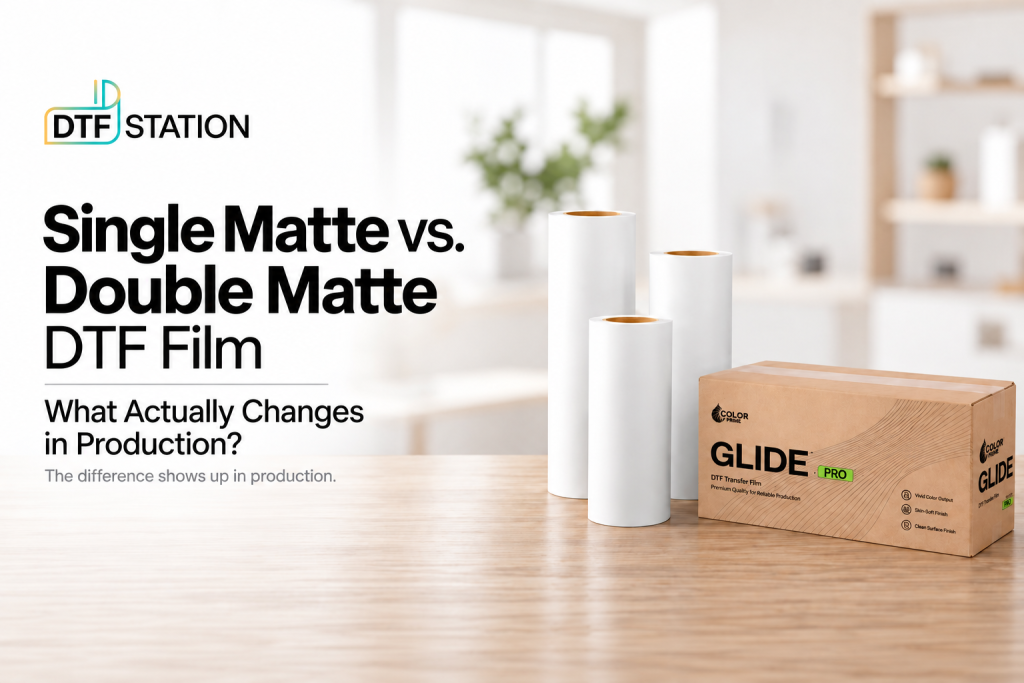
If you compare DTF films, you will quickly see two descriptions:
Single matte and double matte.
But does double matte automatically give better color, softer transfers or better washability?
No.
The biggest difference is usually much earlier in the workflow:
Single vs. double matte primarily changes how the film behaves while moving through production—not automatically how the finished transfer looks.
For print shops, the practical differences are film feeding, friction, static control and long-run stability.
Single Matte vs. Double Matte DTF Film: Quick Answer
| Single Matte | Double Matte | |
|---|---|---|
| Printable surface | One coated side | One coated side |
| Back side | Usually smoother PET | Functional matte treatment |
| Roller grip | Standard | More controlled |
| Static control | Depends on film/environment | Back treatment can improve control |
| Print-side identification | Usually easier | Can be harder |
| Long roll production | Can work well | Often better suited to demanding roll-fed workflows |
| Better color automatically? | No | No |
| Both sides printable? | No | Usually no |
A double-matte film still normally has a designated printable side. The reverse coating is commonly intended for handling, grip or static control rather than ink reception.
What Is Single Matte DTF Film?
Single-matte DTF film normally has a functional ink-receptive/release coating on the printing side while the reverse remains comparatively smooth PET.
That simple construction is not inherently inferior.
If your printer feeds the film reliably, your environment is controlled and your production does not experience significant static or tracking problems, a good single-matte film can work perfectly well.
Its biggest practical advantage is simplicity. The matte print side and smoother reverse are also normally easier for operators to distinguish.
What Is Double Matte DTF Film?
Double matte adds a functional treatment to the back of the PET film.
That backside treatment may be engineered for controlled friction, anti-slip performance, static control or a combination of these properties.
For example, other commercial double-matte films specifically state that their reverse-side coating increases friction to reduce film slipping during feeding.
This is why the real question isn’t:
“Does double matte print better?”
It is:
“Does the second surface treatment make production more controllable on my equipment?”
1. Film Feeding: More Controlled Grip
A smooth PET backside and printer rollers do not always behave the same under every combination of tension, speed, temperature and roll length.
A textured backside can provide more controlled friction as the film passes through the feed system.
In production, that can help reduce:
slipping → tracking movement → operator correction → interrupted runs
This becomes more valuable on longer gang sheets and continuous roll workflows, where a small tracking problem can accumulate over distance.
Printers in community discussions report this distinction as well: users comparing both film types often describe the largest difference as tracking stability on longer production runs rather than a dramatic difference after pressing. That is useful real-world evidence, although it should be treated as operator experience rather than controlled laboratory testing.
2. Static Control: Important, but Don’t Oversimplify It
PET movement can generate electrostatic charge. Static can contribute to film cling, dust attraction, feeding problems and unwanted powder behavior.
This is why many double-matte films incorporate an anti-static backside treatment. Some manufacturers even publish measurable electrical properties; one current commercial film, for example, specifies a surface resistance of 10⁹–10¹¹ Ω/sq for its anti-static coating. That number belongs to that particular film—not to all double-matte films—but it demonstrates that anti-static performance can be an engineered, measurable property rather than simply a marketing phrase.
However:
Double matte does not make the rest of your static-control workflow irrelevant.
Humidity, equipment grounding, film formulation, roller condition and the production environment can all contribute. Community troubleshooting shows operators encountering static-related problems even while using matte films, which is why changing film alone should not automatically be treated as the cure for every static problem.
3. Long-Run Production: This Is Where the Difference Matters More
A short test print tells you whether a film can print.
It doesn’t necessarily tell you how the film behaves after meters of continuous feeding.
For production shops, the more useful questions are:
Does tracking remain stable? Does static increase? Does the operator need to readjust the roll? Does stray powder appear outside printed areas? Does the next roll behave like the previous one?
That is why double matte tends to become more relevant as a workflow moves toward long gang sheets, roll-to-roll production and less operator supervision. Current industry guidance commonly positions double-matte film around these continuous-production needs.
Does Double Matte Produce Better Print Quality?
Not automatically.
This is one of the most important distinctions when evaluating DTF film.
The backside coating mainly affects how the carrier behaves mechanically.
Color density, fine-detail reproduction, ink bleeding, peel behavior and finished hand feel depend much more on factors such as:
print-side coating chemistry + coating uniformity + ink + powder + curing + pressing
Two double-matte films can therefore perform very differently.
And a high-quality single-matte film may outperform a poorly controlled double-matte film.
“Double matte” describes part of the construction. It is not a complete quality specification.
Can You Print on Both Sides of Double Matte DTF Film?
Usually, no.
This is a surprisingly common source of failed prints.
Both sides may look frosted, but one surface is normally the ink-receptive print side, while the other is the functional backside coating.
A recent commercial-printing troubleshooting discussion shows exactly this confusion: a user assumed double-sided film could be printed either way, while experienced operators pointed out that the reverse matte surface existed for feeding rather than printing.
Always follow the supplier’s roll orientation or print-side markings.
If you are testing unfamiliar film, use a scrap section rather than guessing based only on appearance.
Which Side of Double Matte DTF Film Do You Print On?
Print on the designated ink-receptive side.
With single matte, this is often visually obvious because the reverse is glossier.
With double matte, the two surfaces can look similar. That makes manufacturer markings, roll orientation and documentation more important. Some suppliers recommend testing a scrap piece because the printable surface responds differently to water-based liquid than the functional backside coating.
Do not assume:
matte = printable
when both sides are matte.
Single Matte or Double Matte: Which Should You Choose?
Choose based on your production problem—not on which specification sounds more premium.
Single matte makes sense when: your current feeding is stable, static is well controlled, production runs are relatively straightforward and material cost is a major priority.
Double matte becomes more valuable when: you run long rolls, tracking or slippage is a concern, static regularly affects production, or reducing operator intervention is worth more than simply minimizing film cost.
Neither construction wins every workflow.
A Better Way to Test DTF Film
Do not evaluate film only by printing one attractive graphic.
That mostly tests whether the film works.
For a production comparison, keep the printer, RIP settings, ink, powder and job the same, then compare the variables that actually matter over a representative production run:
feeding stability → tracking → static → stray powder → operator intervention → print detail → release → roll-to-roll repeatability
That test tells you much more than comparing how bright two uncured prints look on the carrier.
Where Glide Pro™ Takes the Idea Further
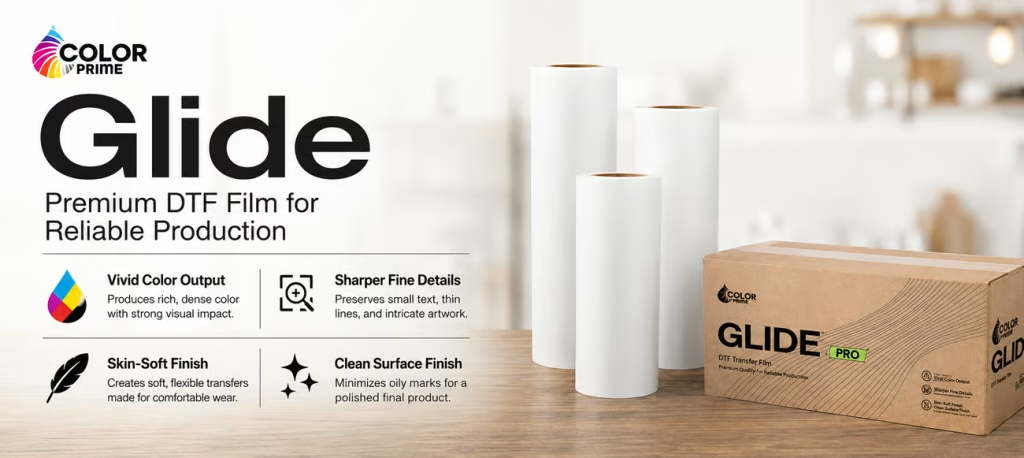
With Glide Pro™, we use double-sided matte construction to support stable film feeding and reduce static-related handling issues.
But double matte is only one part of the film.
Glide Pro™ also uses an extra fine-detail protection layer intended to keep small text, fine lines, logos and edges more complete through printing, curing, peeling and transfer.
More importantly, we treat consistency as a manufacturing-control problem.
In our film production process:
0.05 µm coating-thickness measurement accuracy is used to monitor coating control; a 40 m/min stability-first coating speed is used on the line; a self-adjusting V-slot coating head compensates in real time for base-film variation; and full-roll thickness checks are performed to verify consistency across the film.
Automated coating control, real-time thickness monitoring, controlled production conditions and 100% roll inspection are then used to support more repeatable performance from roll to roll.
That distinction matters:
Double matte can improve how film moves. Consistent coating determines whether the film itself behaves consistently.
Those are related—but they are not the same thing.
FAQ: Single Matte vs. Double Matte DTF Film
Is double matte DTF film better than single matte?
Not universally. Double matte can provide advantages in feeding, friction and static control, especially in continuous roll production. Finished-transfer quality still depends heavily on print-side coating chemistry and the rest of the DTF process.
Does double matte mean both sides are printable?
No. Most double-matte DTF films still have one designated ink-receptive printing side and one functional backside treatment.
Does double matte stop static?
It can help control static when the backside includes an anti-static treatment, but static is also affected by environment, grounding, equipment and film formulation.
Does double matte make DTF prints softer?
Not by itself. Hand feel is mainly influenced by ink and powder laydown, artwork coverage, adhesive chemistry, transfer conditions and the film’s print-side/release system.
Does double matte improve color?
Not automatically. Better color from one film versus another usually indicates differences in the print-side formulation or coating control, not simply that the reverse side is matte.
Why does my DTF film keep slipping or skewing?
Check roll alignment, feed/take-up tension, roller condition, static and the film’s backside surface. A double-matte or anti-slip backside may help when insufficient grip is contributing to the problem, but film is only one variable.
Bottom Line
The difference between single matte and double matte is easier to understand when you stop treating “matte” as a print-quality rating.
Single matte can be an effective, economical choice when the production line already handles film reliably.
Double matte adds another functional surface that can improve grip, static control and feeding stability—advantages that become more valuable as production gets longer, faster and more automated.
But the film you should trust is not simply the one with more coatings.
It is the one that gives you:
stable feeding + controlled coating + clean detail + predictable release + repeatable results from roll to roll.